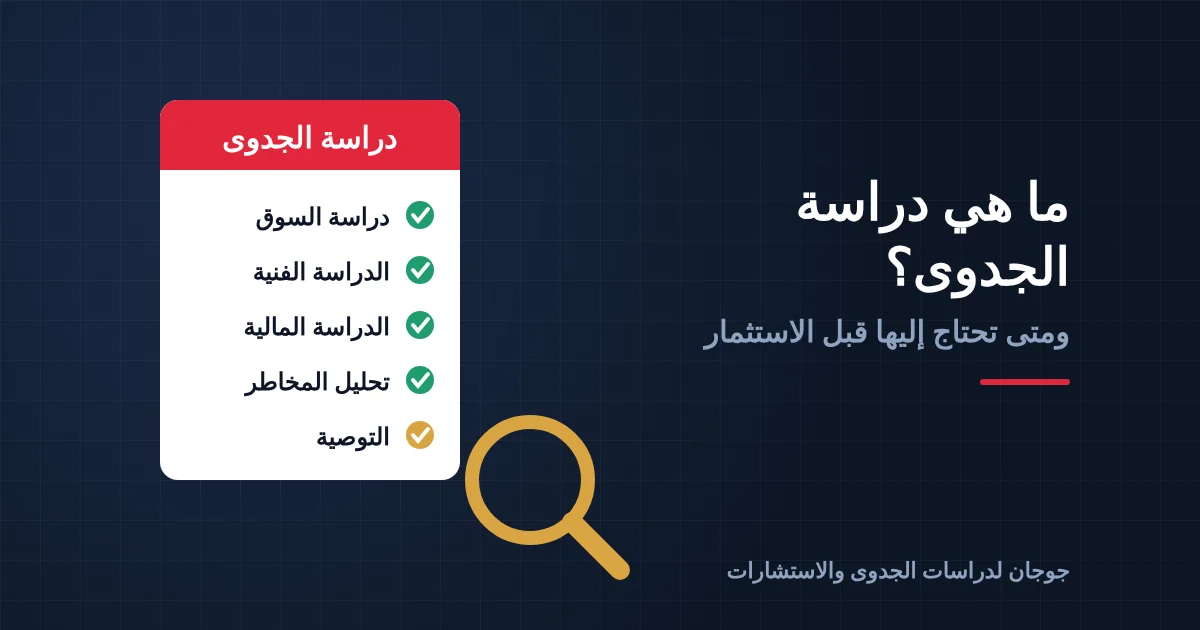
A feasibility study turns a project idea into an investment decision grounded in evidence. It combines market understanding, technical and operational requirements, financial projections, and risk assessment before capital is committed.
What Is a Feasibility Study?
A feasibility study is a structured analysis that tests whether a project can succeed before execution. It defines the concept and target market, evaluates demand, competition, operations, costs and revenues, and concludes with financial indicators and practical recommendations.
A good study is not designed to prove that an idea will work. Its purpose is to test the idea objectively and reveal strengths, risks, and critical assumptions.
What Does a Comprehensive Feasibility Study Include?
- Market size, demand, and target-customer analysis.
- Competitor analysis, competitive advantage, and market opportunities.
- Technical, operational, and resource requirements.
- Capital expenditure, operating costs, and revenue estimates.
- Financial analysis, risks, scenarios, and recommendations.
How Is a Feasibility Study Prepared?
- Understand the Project: Define the concept, objectives, business model, sector, and target market.
- Collect and Analyze Data: Study the market, demand, competitors, and relevant project data.
- Technical and Financial Analysis: Estimate requirements, costs, revenues, and financial indicators.
- Findings and Recommendations: Evaluate scenarios and risks and provide an actionable recommendation.
When Do You Need a Feasibility Study?
A feasibility study is useful when launching a new venture, expanding an existing business, entering a new market, introducing a product or service, seeking finance, or bringing in an investor. The larger and more complex the decision, the more valuable a documented analysis becomes.
The value of a feasibility study is not its page count, but the quality of data, assumptions, methodology, and relevance of the conclusions to the investor's actual decision.
Frequently Asked Questions
Does a feasibility study guarantee success?
No. It reduces uncertainty and clarifies risks and opportunities, but it cannot eliminate execution risk or market change.
How long does a feasibility study take?
Timing depends on project complexity, study scope, and data availability and is confirmed after requirements are reviewed.
Can an old feasibility study be updated?
Yes. Market assumptions, costs, revenues, and financial indicators can be updated using current data.
What is the difference between a preliminary and a detailed feasibility study?
A preliminary study quickly tests the idea with initial data; a detailed study goes deep into market, operations, financial model and risk to support investment or funding decisions.