Professional Studies Aligned with Project and Stakeholder Requirements
Feasibility Study Consulting in Riyadh for Saudi Investment Projects
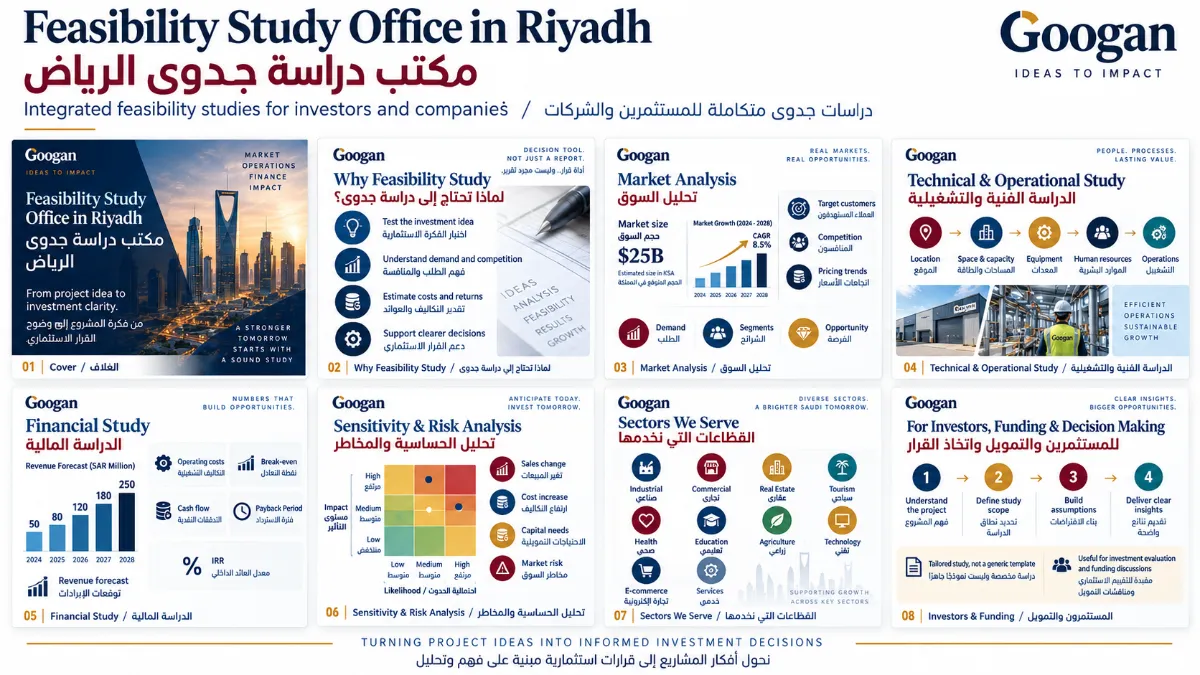
Googan provides professional feasibility study services for investors, entrepreneurs, established companies, and organizations evaluating new business opportunities across Saudi Arabia. Our work is structured around a fundamental principle: an investment study should reflect the economics of the actual project rather than force every business idea into the same generic template.
From early-stage concepts to expansion projects, our feasibility assignments are developed around the commercial model, target market, location, investment scale, operating requirements, revenue structure, and objectives of the client. This enables decision-makers to examine an opportunity from multiple perspectives before committing significant capital.
For businesses searching for a feasibility study office in Riyadh, Googan offers a structured approach that connects market intelligence with technical requirements and financial modelling. The purpose is not simply to produce a formal report. It is to create a decision-support document that allows investors to understand what needs to happen for a project to operate, compete, generate revenue, and reach financial sustainability.
Turning an Investment Concept into a Measurable Business Case
A promising idea and a feasible business are not necessarily the same thing. Before an investor enters a market, several commercial questions need to be addressed. Who will buy the product or service? How large is the relevant customer base? What alternatives already exist? What pricing level can the market support? How much capacity should be developed? What investment will be required before operations begin?
A feasibility study brings these questions into one analytical framework.
At Googan, the process begins by defining the investment concept and understanding what the client intends to achieve. An entrepreneur testing a new concept requires a different analytical approach from an established company considering additional production capacity. Likewise, a project seeking external financing may require a different structure from an internal corporate investment assessment.
This initial definition is important because it determines what should be investigated and how deeply each component should be analysed.
Saudi Market Research and Commercial Assessment
Market assessment provides the commercial foundation of the feasibility study. Financial projections become considerably more useful when the assumptions behind sales volumes, pricing, customer acquisition, and growth are supported by an understanding of the market.
Depending on the industry and availability of reliable information, our research may examine market characteristics, customer segments, demand drivers, competitive activity, pricing structures, distribution channels, purchasing behaviour, sector developments, and other variables relevant to the proposed business.
The analysis is designed around the specific market in which the company intends to operate. A national industrial project may require a Saudi-wide assessment, while a retail, healthcare, hospitality, or service business may depend much more heavily on city-level or catchment-area demand.
Competition, Positioning and Market Entry
Understanding competitors involves more than identifying companies offering similar products. Investors need to understand what customers can already access, how alternatives are priced, how competitors reach their customers, and where a new entrant could potentially establish a differentiated position.
For this reason, competitive analysis can be used to inform decisions relating to product positioning, service configuration, capacity, pricing, sales channels, and market entry.
The objective is not to assume that the project will capture a predetermined market share. Instead, market findings are incorporated into the commercial assumptions used later in the feasibility model.
Technical and Operational Feasibility
A commercially attractive market does not automatically mean that a project can be implemented efficiently. The operating model must therefore be examined alongside demand.
Technical analysis varies significantly by industry. For a manufacturing investment, the assessment may involve production capacity, machinery, raw materials, utilities, storage, logistics, facility requirements, and staffing. For a digital business, the relevant requirements may include platform architecture, technology infrastructure, payment systems, fulfilment, customer service, cybersecurity, and digital acquisition channels.
Service businesses may require a different combination of premises, personnel, equipment, operating procedures, and customer capacity.
Googan develops this part of the study according to the practical requirements of the business rather than applying a standard technical checklist to unrelated industries.
Capital Expenditure and Operating Cost Structure
One of the most important outputs of technical planning is a clearer understanding of how much capital the business may require.
The investment structure can include premises, fit-out, equipment, machinery, technology, pre-operating expenditure, initial inventory, professional services, and working capital depending on the business model.
Operating expenditure is assessed separately and may include payroll, rent, utilities, maintenance, marketing, logistics, technology subscriptions, administrative expenses, direct operating costs, and other recurring commitments.
Separating and structuring these costs helps investors understand both the initial funding requirement and the ongoing financial resources needed to operate the business.
Financial Feasibility and Investment Modelling
The financial model brings together the assumptions developed throughout the study. Expected demand influences revenue. Capacity affects potential sales volumes. Staffing and technical decisions influence operating expenditure. Capital requirements affect funding needs and investment returns.
By connecting these variables, the feasibility study can evaluate how the proposed business may perform under a defined set of assumptions.
Depending on the assignment, financial analysis may include projected revenues, operating costs, profitability, cash flows, capital expenditure, working capital requirements, and funding needs.
Investment indicators can also be calculated where relevant to the project. These may include break-even analysis, payback period, Net Present Value, Internal Rate of Return, Return on Investment, and other measures appropriate to the investment structure.
The objective of these indicators is not to replace management judgement. Their value lies in providing decision-makers with measurable information that can be compared with the required capital, commercial opportunity, and level of risk.
Sensitivity Testing and Alternative Scenarios
A financial forecast is based on assumptions, and assumptions can change.
Sales may develop more slowly than expected. Input prices may increase. Payroll expenses can change. Construction or equipment costs may exceed early estimates. Selling prices may face competitive pressure.
Sensitivity analysis helps investors understand what happens when important variables move away from the base assumptions.
Where appropriate, different scenarios can be developed to examine the financial consequences of changes in sales, pricing, investment cost, operating expenses, or other critical variables. This provides a more informative view of the investment than relying solely on a single forecast.
Feasibility Studies Across Multiple Industries
Saudi Arabia offers investment opportunities across a broad range of economic sectors, but each sector requires a different analytical perspective.
Googan's feasibility study services can support industrial, commercial, healthcare, education, tourism, hospitality, agriculture, technology, real estate, professional services, e-commerce, and other investment activities.
An industrial feasibility study, for example, may depend heavily on production capacity, raw-material availability, imported alternatives, machinery, utilities, and logistics. A healthcare investment may require a stronger focus on target population, service demand, clinical capacity, staffing, and facility requirements.
An e-commerce business introduces another set of commercial drivers, including customer acquisition, digital conversion, product margins, fulfilment, returns, inventory management, and platform operating costs.
This is why sector-specific thinking is essential when preparing an investment study.
## Feasibility Studies for Funding and Stakeholder Review
Some feasibility studies are commissioned entirely for internal decision-making. Others may ultimately be reviewed by financing institutions, investors, partners, or other stakeholders.
The intended use of the study should therefore be discussed at the beginning of the engagement.
When a client has specific guidelines, templates, information requirements, or documentation issued by the relevant financing or stakeholder organization, these materials can be provided to Googan and considered within the agreed scope of work.
Requirements can differ by institution, financing programme, industry, project size, and stage of application. We therefore avoid treating funding requirements as universal or assuming that one report format will satisfy every institution.
Built Around the Project, Not Around a Template
Two investments operating in the same sector can have completely different economics.
Location can alter demand and rental costs. Capacity changes capital expenditure. The target customer affects pricing. Distribution strategy influences margins. Financing structure changes cash flow. Even the timing of implementation can materially affect the investment case.
For this reason, Googan develops the study around the project's actual characteristics.
The engagement begins with information gathering and project definition. The research and modelling requirements are then determined according to the questions that need to be answered. This approach keeps the report focused on decision-relevant information rather than increasing its length with generic material.
Economic Feasibility Study Office in Riyadh Serving All of Saudi Arabia
Investors often search for an "economic feasibility study office" or "certified feasibility study offices" when they need a study to support an investment decision or a financing application. Googan has worked in this field since 1996 — more than 30 years — from its office in Riyadh, serving investors and companies in Riyadh, Jeddah, Dammam and across the Kingdom.
How to choose a certified feasibility study office
- A valid commercial registration and licence.
- Quality certificates that can be verified with the issuing body.
- Experience in your sector and with the requirements of the body that will receive the study.
- A clear methodology and reviewable financial assumptions.
- An agreed scope, deliverables and timeline before work starts.
What Googan offers
- Experience since 1996 in feasibility studies and economic consulting.
- ISO 9001 quality-management certification, active and verifiable with the issuing body.
- Economic, financial, technical and market studies prepared to the requirements of the target body, such as the Saudi Industrial Development Fund and other financing bodies where needed.
- A study built for each project, not a ready-made template.
A Riyadh-Based Feasibility Study Partner
Businesses looking for a feasibility study office in Riyadh often need more than financial spreadsheets. They need a team capable of understanding how the commercial, operational, and financial components of an investment interact.
Googan approaches feasibility studies as integrated business assessments. Market findings should influence revenue assumptions. Technical requirements should feed into investment costs. Staffing plans should appear in operating expenses. Capacity assumptions should correspond with projected sales.
This connection between different sections is essential because inconsistencies can significantly distort an investment assessment.
Our aim is to present the assumptions and results in a structure that investors and management teams can review, discuss, and use during the decision-making process.
Start Your Feasibility Study with Googan
Whether you are evaluating a new business, expanding an existing operation, introducing a new product line, entering the Saudi market, or preparing an investment opportunity for stakeholder review, the first step is to define the project clearly.
Clients can provide Googan with an initial description of the business, proposed location, sector, expected investment scale, current stage of development, available project information, and the purpose for which the feasibility study is required.
Based on this information, the appropriate scope can be established before the assignment begins.
A professional feasibility study should ultimately help management answer a practical question: under the assumptions supported by the available market, technical, operational, and financial information, what does this investment require and what do its projected economics look like?
For investors seeking a feasibility study office in Riyadh with experience across Saudi business sectors, Googan provides a structured service designed to transform investment concepts into measurable business cases and support more informed capital decisions.
Project-specific study
Market, technical & financial analysis
Alignment with target-entity requirements
Final review & recommendations
Documents Covered by the Service
Project information Authority requirements if available Project location Activity and expected capacity