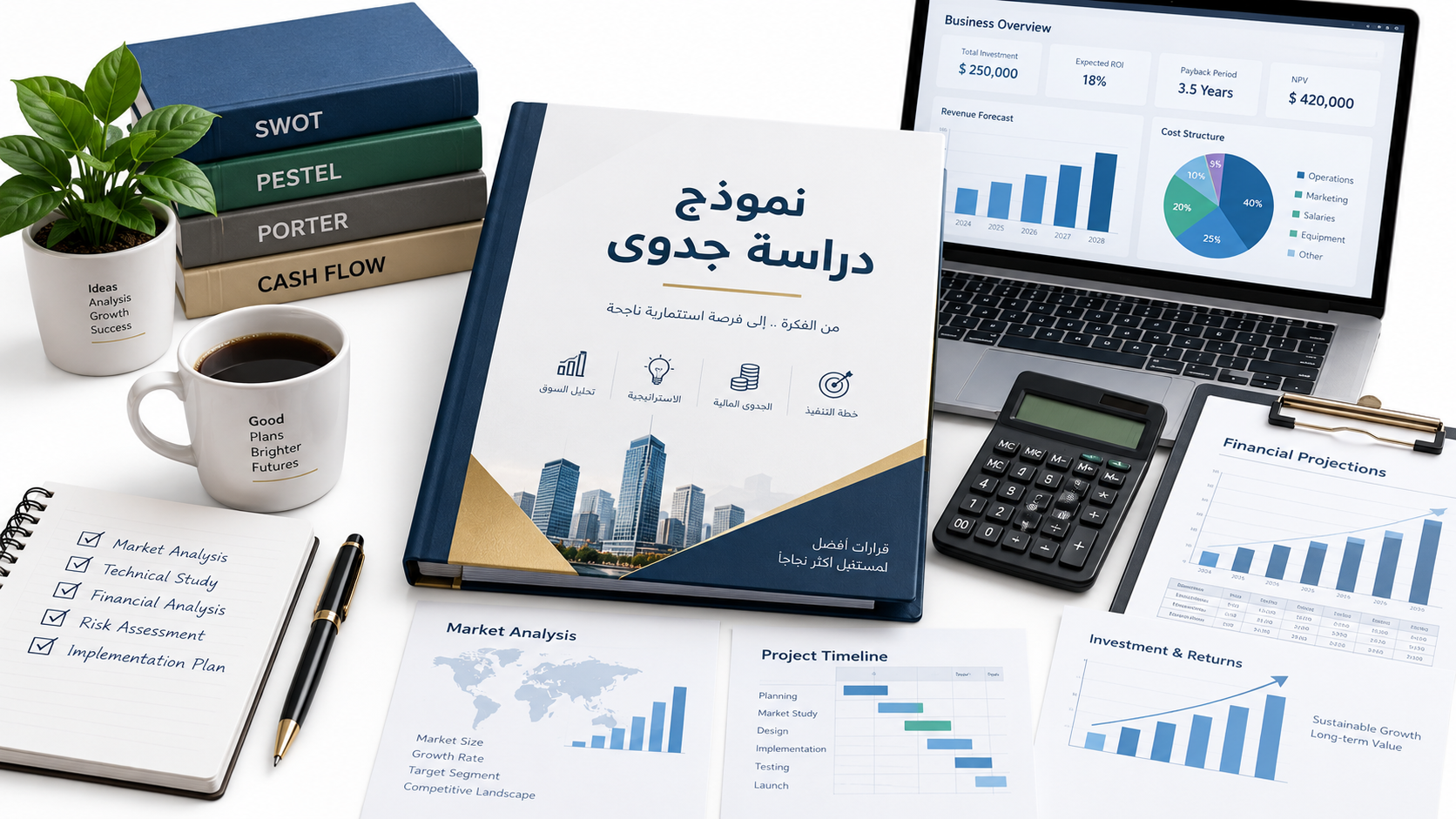
Building a Feasibility Study That Supports an Investment Decision
Core Components of a Feasibility Framework
An effective feasibility framework connects commercial, operational and financial assumptions. Market evidence should support revenue expectations, operating design should explain cost assumptions, and financial modelling should test whether the proposed business can sustain its obligations under realistic conditions.
Templates are useful for structure, but investment decisions require project-specific assumptions. Market conditions, operating costs, customer behaviour and financing needs should be evaluated independently for each business.
Supporting Feasibility Models
- Comprehensive Feasibility Study Model
- Project Financial Model
- Cash Flow Model
- SWOT Analysis Template
- Porter’s Five Forces Model
- PESTEL Analysis Framework
- Sensitivity Analysis Model
- Contingency and Risk Plan
- Market and Competitor Analysis
- Financial Scenario Model
Feasibility Study Development Process
Choosing the Right Feasibility Study Model
A useful feasibility model should match the type of decision being made. A startup concept may require a compact market and financial framework, while an industrial or capital-intensive project may need detailed operational assumptions, equipment planning, working-capital analysis, funding requirements and risk scenarios.
The strongest models are flexible rather than static. They allow assumptions such as pricing, sales volume, operating costs, staffing and investment levels to be adjusted so that decision-makers can understand how changes affect the project.
Strategic tools may also be added where appropriate. SWOT helps assess internal and external factors, PESTEL evaluates the wider business environment, and Porter’s Five Forces supports competitive analysis. Financial modelling, cash-flow forecasting and sensitivity analysis should then connect those strategic assumptions to measurable outcomes.
A feasibility template should therefore be selected according to the project, sector and intended use—not simply because it is available as a ready-made document.
A good feasibility model does not simply organize information; it turns project assumptions into measurable investment decisions.
Questions we received about the topic
1. What is a feasibility study framework?
It is a structured method for evaluating market potential, operational requirements, financial assumptions and project risks before an investment decision is made.
2. Can one feasibility template be used for every project?
No. A common structure can be reused, but assumptions and analysis must reflect the specific sector, market and operating model.
3. Why is cash flow important?
Cash flow reveals whether the business can meet its financial obligations at the right time, even when accounting profits appear positive.
4. What is sensitivity analysis?
It tests how changes in critical assumptions such as sales, costs or pricing may affect project outcomes.
5. Why use SWOT in feasibility analysis?
SWOT helps organize internal strengths and weaknesses alongside external opportunities and threats.
6. What does PESTEL evaluate?
It examines external political, economic, social, technological, environmental and legal factors.
7. Is a financial model enough?
No. Financial projections should be supported by credible market, technical and operational assumptions.