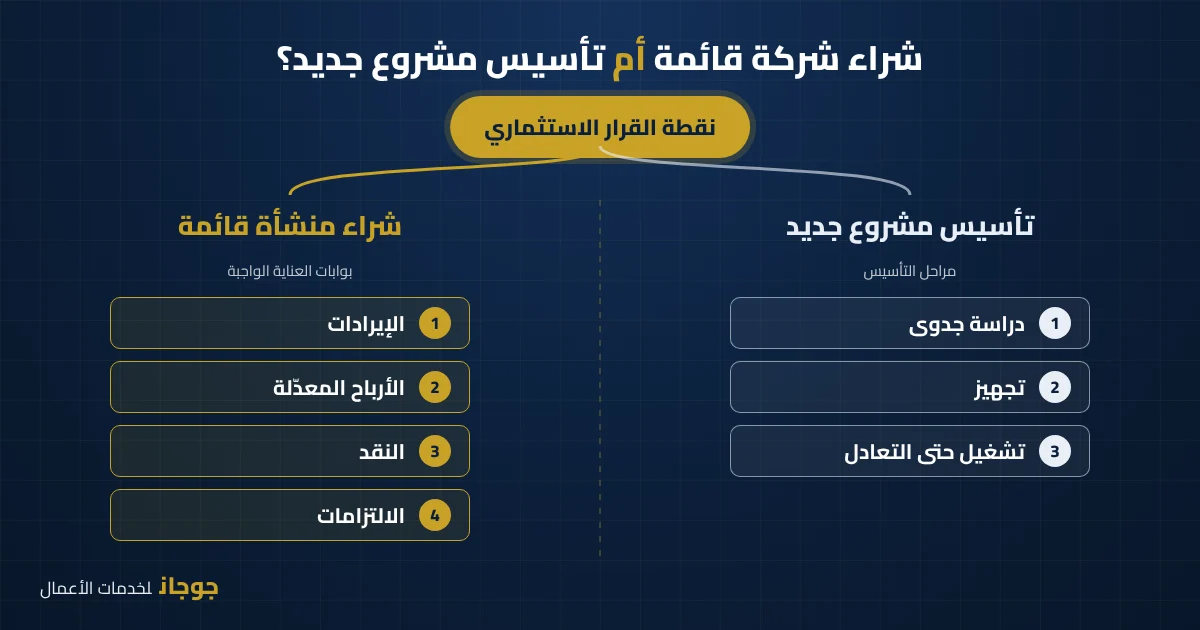
The seller shows you the company’s past: financial statements for previous years, a customer list, and equipment that works. What you are paying for, however, is its future: the revenue that will materialize after the owner exits, the profit that remains once non-recurring items are adjusted, and the cash that will actually reach your account. The short answer: buying an existing business is better than starting one when revenue is recurring and transferable to you, adjusted earnings justify the price, and liabilities are known and can be priced into the deal. Starting a new business is better when what you would really be buying is a name and personal relationships tied to the seller, or when the cost of fixing the existing business exceeds the cost of building a new one to the specifications you want. The only way to tell the two situations apart is structured due diligence before signing, not after.
This is an analytical advisory guide covering the commercial and financial aspects. Legal and tax matters are addressed only insofar as they affect the investment decision, with clear indication of where a qualified lawyer or accountant must be involved; the guide does not offer a definitive opinion on them.
What are you actually buying when you buy an “existing business”?
The first question is not “What is the price?” but “What will be transferred to me?” In practice there are two main structures, each with a different effect on risk:
| Structure | What is transferred | Effect on the buyer (professional analysis) |
|---|---|---|
| Buying the shares or equity interests in the company | The legal entity itself, with all its rights and obligations | Contracts and licenses usually transfer with the entity, but so do past liabilities, both known and unknown |
| Buying the assets or the business | Specific assets and operations transferred to the buyer’s entity | In theory you can choose what you buy, but some contracts, licenses and employees do not transfer automatically and require separate procedures |
For a sole proprietorship specifically, the Ministry of Commerce guide to the service for transferring ownership of a sole proprietorship’s commercial registration (last updated 22/06/2025) explains that the transfer is completed electronically through the Saudi Business Center platform, and that the new owner accepts the request with an undertaking to assume all obligations relating to the current owner’s account (Ministry of Commerce — service guide). Documented fact. In practical terms, “buying the establishment” may also mean buying its liabilities, which is why examination must precede signing the transfer.
For companies, the transfer of shares and equity interests is governed by the Companies Law issued by Royal Decree No. (M/132) dated 1/12/1443H and by the company’s articles of association or bylaws, which may include restrictions or pre-emption rights for the other partners. Choosing the appropriate structure and its regulatory implications is a decision to be made with a qualified lawyer; the role of investment analysis here is to show how risk and value change between the two structures.
When is buying smarter than starting, and when is the reverse true?
There is no general answer. What exists is a set of conditions; when most of them are met, the balance tips toward one option. The following table is professional analysis, not a regulatory rule:
| Factor | Favors buying when… | Favors starting when… |
|---|---|---|
| Time to market | Delay is costly, and licensing and set-up take a long time | There is no pressing time window |
| Source of revenue | Revenue is tied to contracts or an operating system, not to the seller personally | Revenue is based on the owner’s personal relationships |
| Assets | Equipment is in good condition and serves your plan | You need technology or production capacity different from what exists |
| Location | The site itself is an advantage that is hard to replicate | The current location constrains expansion or access to customers |
| Liabilities | They are known, documented and can be deducted from the price | They are unclear or difficult to measure |
| Culture and team | The team can operate without the owner | Operations depend on the owner or on individuals who may leave |
| Price | The price is close to the value of adjusted earnings | The price includes a premium for “reputation” that does not appear in the numbers |
When location is a decisive factor, buying an existing business also means buying its location. In that case, it helps to compare the offered location against alternatives using a clear methodology, as in the encyclopedia guide: Riyadh, Jeddah or Dammam? How to choose the best location for your project.
Is the revenue real and recurring?
Not all revenue is of equal value. Revenue that recurs every month under an annual contract differs from revenue that came from a single tender that will not be repeated. The questions that separate the two:
- Does the reported revenue match independent sources? Compare the financial statements with the tax returns filed, bank statements and e-invoices. Unexplained discrepancies are a signal worth stopping for.
- What share of revenue is recurring? Classify revenue into: active, renewing contracts; repeat customers without a contract; and one-off revenue.
- Is revenue declining month by month even though the annual total is stable? The annual total may hide a downward trend in recent months, which are precisely the months that precede the seller’s decision to sell.
- Are prices sustainable? Temporary discounts or preferential prices for customers connected to the seller may disappear after the change of ownership.
Is the reported profit the profit you will receive?
This is the essence of what is known as “quality of earnings” analysis. Profit in the financial statements of small and medium-sized enterprises is heavily influenced by the owner’s decisions: a salary they do not draw, preferential rent from a relative, or personal expenses charged to the company. What is needed is an “adjusted profit” that reflects what you will see after the acquisition.
Hypothetical illustrative example — all figures are assumed for educational purposes only and do not represent a real business:
Assumptions: reported net profit for the last year of SAR 1,200,000; the owner runs the company without a salary, and the market cost of a replacement manager is assumed at SAR 360,000 per year; a one-off contract contributed a profit of SAR 250,000; the building is leased from a relative of the seller at below-market rent, with an assumed difference of SAR 150,000 per year; a non-recurring legal expense of SAR 80,000; the seller is asking for a price equal to 4 times reported net profit.
| Item | Impact (SAR) |
|---|---|
| Reported net profit | 1,200,000 |
| Less: replacement manager’s salary | (360,000) |
| Less: profit from non-recurring contract | (250,000) |
| Less: rent difference on moving to market rate | (150,000) |
| Add: non-recurring legal expense | 80,000 |
| Adjusted profit | 520,000 |
At the same multiple the seller is asking for (4 times), the price equivalent to adjusted profit becomes SAR 2,080,000 instead of SAR 4,800,000. The difference does not mean the “correct” price is 2,080,000; the multiple itself is an assumption that needs justification, and formal valuation falls to a specialized party (see the section “Enterprise value is not the deal price”). The lesson is that negotiating the price before adjusting earnings is negotiating over the wrong number.
To test the statements themselves using financial ratios over three years, you can use the free financial analysis and financial statement ratios tool in the GOOGAN Encyclopedia.
Does the profit convert into cash?
A company that is profitable on paper may need continuous funding from its owner because its profits are locked up in receivables and inventory. Examine:
- The average collection period and its trend, the aging of receivables, and the share of debts overdue by more than a year.
- Inventory: is it actually saleable, or does it include slow-moving items carried at cost?
- The difference between net profit and operating cash flow over several years. A gap that keeps widening needs an explanation.
- The working capital required for normal operations: this is an amount the company should already hold when you take it over, not one you are forced to inject after the acquisition. In many deals, a reference level of working capital is agreed and the price is adjusted according to deviation from it; drafting this clause in the contract is the work of the lawyer and the accountant.
Who are the customers this income depends on?
Revenue concentration is a risk that does not appear in the income statement. If one or three customers account for a large share of revenue, you are in fact buying a relationship with those customers, which may end when a contract expires or when the seller exits.
- Request the breakdown of revenue by customer for at least three years, and calculate the share of the largest customer and the five largest customers.
- Review the remaining terms of contracts and renewal conditions, and whether the contracts include clauses allowing the customer to terminate upon a change in the supplier’s ownership. Interpreting these clauses is legal work.
- If revenue comes from government or competitive tenders, check whether it is tied to a qualification or classification specific to the current establishment.
- Where possible, with the seller’s consent and at an advanced stage, speak with a number of key customers. Direct conversation reveals what the numbers do not.
What is hidden in the liabilities and contracts?
This is where financial due diligence intersects with legal and tax due diligence. The following is a list of what you should request and understand the financial impact of; judging its regulatory validity is the work of specialists:
- Debts and facilities: bank loans, personal guarantees and sureties, liens on assets, and accelerated repayment terms upon a change of ownership.
- Obligations to employees: accrued end-of-service benefits, overdue salaries and entitlements, and how consistently employees have been registered and contributions paid to the General Organization for Social Insurance (GOSI).
- Zakat and taxes: returns filed, and any outstanding assessments or objections. The Zakat, Tax and Customs Authority (ZATCA) provides a Zakat certificate verification service using the commercial registration number or the certificate number. Documented fact. However, a valid certificate does not mean the absence of any potential liability for prior years, and assessing this risk is the work of an accountant or a Zakat and tax advisor.
- Operating contracts: the site lease, its remaining term and whether it can be transferred, exclusive supply contracts, and maintenance and warranty obligations to customers.
- Existing or potential litigation and disputes, which is entirely a legal review.
Can the assets and equipment carry your plan?
The book value of equipment is an accounting figure, not a report on its condition. The questions that matter to you as an investor:
- What is the remaining operating life of the main equipment, and when is replacement due? If the business plan requires replacing a production line within two years, that is a cost that must appear in your evaluation of the deal.
- Are spare parts and maintenance for this equipment available in the local market?
- Is the actual production capacity sufficient for the growth you are assuming? And what is the current utilization rate?
- Are the assets in use actually owned by the company, or are they leased or personally owned by the seller?
A technical inspection of equipment requires a technical specialist in the sector. And if the deal is the purchase of a factory, understanding the market for the product itself matters more than the condition of the machines; here the encyclopedia guide is useful: Do rising imports mean an opportunity to build a factory? How to read import data, because the same question applies to an existing factory: is its market expanding, or is competition eating into it? And if your plan after the acquisition is to upgrade the factory rather than operate it as is, the difference between an upgrade study and a new-build study is explained in the article Ready-made garment factory feasibility study: when do you need an upgrade study for an existing factory?.
Does the business stand on its own, or on its owner?
Many small and medium-sized enterprises are in reality an extension of their owner: the owner is the one who knows the customers, negotiates with suppliers and solves problems. When the owner leaves, part of the value leaves too.
- Identify the people who are indispensable, and whether they will stay after the sale, and on what terms.
- Measure how dependent operations are on the seller: who signs, and who owns the relationship with the largest customers and suppliers? The deal may need a transition period during which the seller stays on, and this is a negotiable term.
- Check the establishment’s status in the Nitaqat program: the Ministry of Human Resources and Social Development provides, through the Qiwa platform, an establishment Nitaqat inquiry service that shows its classification (Platinum, Green, Yellow, Red) according to compliance with Saudization ratios. Documented fact. The classification affects the establishment’s ability to complete labor-related services.
- In asset deals: if expatriate employees will move to the buyer’s entity, the transfer of their services is carried out through the Qiwa platform (Expatriate employee transfer request service — Ministry of Human Resources). The conditions of transfer and its effect on employees’ rights should be reviewed with a labor law specialist.
Licenses and regulatory obligations: what does not transfer on its own?
This section identifies the areas of regulatory risk you need to know about before negotiating, not the final judgment on them.
VAT on the transfer of a business. The ZATCA guideline on the transfer of an economic activity (third edition, May 2026) explains that Article 17 of the Implementing Regulations of the VAT Law sets conditions for treating the transfer of a business as outside the scope of VAT, including: that the transferred assets constitute a standalone economic activity, that the recipient is registered or becomes registered, that the activity continues in the same manner, and that the two parties agree in writing on this treatment, with notification to the Authority within the specified deadline. If the conditions are not met, the transaction is treated as a taxable supply. Documented fact (summarized from the guideline). This directly affects the deal’s cash flow, and applying it to your deal is the work of an accountant or tax advisor.
Real estate within the deal. If the deal includes real estate, Real Estate Transaction Tax may arise, which the Authority states is levied at 5% of the value of the property being sold or whose possession is being transferred. The Authority’s page also indicates that the previous regulations ceased to apply as of 10 April 2025, with reference to the new law and its regulations. Documented fact; application to your case requires a specialist.
Economic concentration. Deals that exceed certain sales thresholds are subject to notification to the General Authority for Competition before completion. According to the guidelines updated in 2025, as summarized in the Clifford Chance briefing and the HFW briefing, three cumulative conditions apply: the parties’ combined worldwide sales exceed SAR 200 million, the target’s worldwide sales exceed SAR 40 million in the case of an acquisition, and the parties’ combined sales within the Kingdom exceed SAR 40 million. Information from a reliable secondary source; we were unable to access the official text on the Authority’s website programmatically, and it must be verified before any large deal. Most small business deals will not reach these thresholds, but an investor who owns other companies should calculate the sales of the entire group with their lawyer.
Activity-specific licenses. Municipal licenses, Civil Defense licenses and sector licenses (health, industrial, education and others) may be tied to the establishment, the site or the person in charge, and each authority has its own procedures. Draw up the list of licenses, the expiry date of each, and whether they will transfer under the structure you have chosen, before you calculate any projections.
Enterprise value is not the deal price
Confusing the two concepts costs buyers dearly:
- Enterprise value is a professional estimate of what the business is worth, based on a specified basis of value and purpose. In the Kingdom, the Saudi Authority for Accredited Valuers (Taqeem) defines business valuation as determining the value of businesses or interests in them according to a purpose and a basis of value, lists mergers and acquisitions among its uses, and requires membership and licensing to practice valuation. Documented fact. Therefore, a formal valuation report, if you need one for financing or for a third party, should be obtained from a licensed accredited valuer.
- The deal price is the outcome of negotiation, influenced by the seller’s need to sell, the number of buyers and the method of payment. What you actually pay for the equity differs from enterprise value by the amount of debt, cash and working capital delivered.
- The payment structure is part of the price: deferred payment, linking part of the price to future performance, or holding back part of it against undiscovered liabilities are all tools that shift part of the risk to the seller. Their legal drafting is the lawyer’s work, while measuring their financial impact is the work of financial analysis.
To evaluate the alternative of starting a new business with the same tools (net present value, internal rate of return and payback period), you can use the investment appraisal calculator in the encyclopedia, so that the deal is compared with a new project on the same cash flow basis.
Commercial and financial due diligence matrix before an acquisition
This matrix is the core tool in this guide. Use it to organize information requests to the seller, allocate the review among specialists, and link each finding to its impact on the decision or the price. An analytical framework prepared by GOOGAN, not a regulatory standard.
| # | Area | What to request from the seller | How to test it | Red flag | Possible impact on the decision | Who reviews |
|---|---|---|---|---|---|---|
| 1 | Revenue validity | 3 years of financial statements, tax returns, bank statements | Reconcile revenue across the three sources | Unexplained discrepancies | Reduce base revenue in the valuation, or stop | Financial analyst + accountant |
| 2 | Revenue recurrence | Revenue analysis by contract, customer and month | Classify as recurring / one-off | Reliance on non-recurring revenue | Exclude it from adjusted profit | Financial analyst |
| 3 | Quality of earnings | Expense details, management salaries and related-party transactions | Adjust non-recurring and non-market items | Profit relying on a zero salary or preferential rent | Reduce adjusted profit and the price | Financial analyst + accountant |
| 4 | Cash conversion | Receivables aging, inventory and operating cash flow | Compare profit with operating cash over the years | Widening gap, overdue debts | Working capital price adjustment mechanism | Financial analyst + accountant |
| 5 | Customer concentration | Revenue by customer and contracts of the largest customers | Calculate the share of the largest customer and the top 5 | One customer with a large share and a short contract | Payment conditional on the customer’s retention, or stop | Commercial analyst + lawyer for contracts |
| 6 | Competition and market | Sales and pricing data, and a list of competitors | Test market and price trends from independent sources | Erosion of market share or falling prices | Adjust growth projections | Market analyst |
| 7 | Debts and guarantees | Financing agreements, liens and sureties | Reconcile them with the statements and bank statements | Undisclosed guarantees or accelerated repayment on change of ownership | Deduction from the price or a settlement condition before completion | Accountant + lawyer |
| 8 | Employee obligations | Payroll, end-of-service benefits and GOSI data | Reconcile headcount across payroll, GOSI and Qiwa | Unrecorded entitlements | Deduction from the price or holdback of part of it | Accountant + labor law specialist |
| 9 | Zakat and taxes | Returns, assessments and certificates | Review open years and objections | Outstanding assessments or unsettled years | Seller warranties and holdback of part of the price | Accountant / Zakat and tax advisor |
| 10 | Assets and equipment | Asset register, maintenance and ownership documents | Technical inspection, and comparison of capacity with the plan | Equipment near end of life, or assets not owned by the company | Add replacement cost to the deal cost | Technical specialist |
| 11 | Team and management | Organizational structure and contracts of key people | Interviews, and identifying dependence on the owner | Operations dependent on the seller alone | Transition period or linking part of the price to performance | Operations analyst |
| 12 | Licenses and compliance | List of licenses and their dates, and the establishment’s Nitaqat status | Verify transferability under the chosen structure | A license that does not transfer or is close to expiry | Defer completion until transfer or renewal | Lawyer + licensing authority |
| 13 | Operating contracts | Lease, supply and customer contracts | Remaining term, and change-of-ownership clauses | Short or terminable lease | Assess the risk of losing the site | Lawyer |
| 14 | Price and payment structure | The seller’s offer and its basis of calculation | Compare it with adjusted profit and the start-up alternative | Price based on unadjusted profit | Renegotiate or withdraw | Financial analyst + accredited valuer where needed |
Suggested use: do not move to final negotiation until each row has a written finding from one of three outcomes: “Clean,” “Priceable risk” (addressed in the price or payment structure), or “Non-priceable risk” (requiring the deal to be reconsidered or abandoned).
Common thinking errors when comparing buying with starting
- “Buying is less risky because the business is already successful”: past success may be tied to the seller or to market conditions that have ended. The risk does not disappear; its nature changes.
- Comparing the purchase price only with the capital cost of starting up: the start-up alternative also includes operating losses until break-even, time, and the probability of failure. The correct comparison is between two complete cash flows.
- Falling in love with the deal: the further negotiations progress and the more is spent on due diligence, the harder it becomes psychologically to walk away. Set your walk-away conditions in writing before you begin.
- Treating a valid certificate as proof that there are no liabilities: certificates confirm a status on a given date and do not cover all potential liabilities.
- Relying on commonly quoted multiples: “businesses in this sector sell for so many times earnings” is usually a statement without a source, and it is no substitute for analyzing the deal itself.
When is the available information not enough to make a decision?
In the following cases, the right course is to defer the decision until the information is complete, or to withdraw:
- The seller refuses to provide bank statements or returns that allow revenue to be reconciled.
- There are no regular financial statements, or personal accounts are mixed with the establishment’s accounts to the point where they cannot be separated.
- Revenue depends on a customer or contract you have not been allowed to review.
- There is a material license whose transfer cannot be confirmed.
Where to involve specialists, in brief:
| Subject | Appropriate specialist |
|---|---|
| Deal structure (shares or assets), share transfer restrictions, and drafting of the sale agreement and warranties | Corporate lawyer |
| Zakat, VAT and Real Estate Transaction Tax and their impact on the deal | Certified public accountant or Zakat and tax advisor |
| Accuracy of the financial statements and unrecorded liabilities | Certified public accountant |
| Formal valuation report for financing or regulatory purposes | Accredited valuer licensed by the Saudi Authority for Accredited Valuers (Taqeem) |
| Employee transfer and employee rights | Labor law specialist |
| Equipment condition and production capacity | Technical specialist in the sector |
| Comparing the deal with the start-up alternative, and testing the market and financial projections | Financial analyst or feasibility study consultant |
Investor questions
Is buying an existing business less risky than starting a new one?
Not necessarily. Buying reduces the risk of there being no demand, but it adds the risks of hidden liabilities, dependence on the seller and overpaying. The comparison is made after due diligence, not before it.
What is the first document I should request from the seller?
Three years of financial statements, together with the tax returns and bank statements for the same period, because reconciling them is the fastest test of revenue validity.
Are audited financial statements enough?
They are an important starting point, but they do not answer commercial questions such as customer concentration, revenue recurrence or the dependence of operations on the owner. These require separate commercial due diligence.
When do I need a valuation from an accredited valuer?
When you need a formal valuation report, for example to submit to a financing body or for a regulatory purpose. Comparing the deal with alternatives and setting your own negotiating ceiling is financial analysis that can precede the formal valuation but does not replace it.
Must every acquisition be notified to the General Authority for Competition?
No. Notification is required when the deal exceeds the sales thresholds set out in the Authority’s guidelines. Verify the applicable thresholds in the official text with your lawyer, and calculate the sales of your entire group.
How long does due diligence take?
It depends on the size and complexity of the business and how quickly the seller provides the documents. There is no standard duration that can be relied upon, and what matters most is that the examination is not cut short because of time pressure imposed by the seller.
Conclusion
The decision to buy or to start is not a personal preference between “ready-made” and “new,” but a comparison between two cash flows with different risks. An existing business is worth buying when its revenue and adjusted earnings withstand scrutiny, its relationships, licenses and team transfer to you, and the price reflects all of that. If that is not the case, starting a new business, despite being slower, may be the less costly option in the long run. Use the matrix above to turn the deal from an impression into a list of priceable findings, and involve the lawyer and the accountant in the areas assigned to them. For more guides on investment decisions in the Kingdom, see the Saudi Investment section of the GOOGAN Encyclopedia.
If you are comparing an acquisition with the alternative of starting a new project, GOOGAN’s Studies and Consulting Division can prepare the economic and financial side of the comparison: a feasibility study for the start-up alternative, and a comparison of investment alternatives and testing of their assumptions as part of the investment advisory service. This role is analytical and does not include brokering the deal, legal opinions, Zakat and tax opinions, or a formal valuation report; these are handled by the specialists listed above. You can request a proposal through the quote request page.
Prepared by: Studies and Consulting Division, GOOGAN Business Services Company
Information last verified: 12 November 2026
Sources
- Ministry of Commerce — Service guide for transferring ownership of a sole proprietorship’s commercial registration (last updated 22/06/2025): https://mc.gov.sa/ar/eservices/Documents/36en.pdf
- Capital Market Authority — New Companies Law page (Royal Decree M/132 dated 1/12/1443H): https://cma.gov.sa/RulesRegulations/New_CompaniesLaw/Pages/default.aspx
- Zakat, Tax and Customs Authority (ZATCA) — Guideline on the Transfer of an Economic Activity under VAT Provisions (Edition 3, May 2026): https://zatca.gov.sa/en/HelpCenter/guidelines/Documents/Guideline-On-Transfer-of-an-Economic-Activity-under-VAT-Provisions.pdf
- Zakat, Tax and Customs Authority (ZATCA) — Zakat certificate verification service: https://zatca.gov.sa/ar/eServices/Pages/ZakatCertificate.aspx
- Zakat, Tax and Customs Authority (ZATCA) — Real Estate Transaction Tax: https://zatca.gov.sa/ar/RulesRegulations/Taxes/Pages/RETT.aspx
- Ministry of Human Resources and Social Development — Establishment Nitaqat inquiry service: https://www.hrsd.gov.sa/en/ministry-services/services/الاستعلام-عن-نطاق-المنشأة
- Ministry of Human Resources and Social Development — Expatriate employee transfer request service: https://www.hrsd.gov.sa/en/ministry-services/services/employee-transfer
- General Organization for Social Insurance (GOSI): https://www.gosi.gov.sa/
- Saudi Authority for Accredited Valuers (Taqeem) — Business valuation sector: https://taqeem.gov.sa/en/sector/business
- General Authority for Competition: https://gac.gov.sa/
- Clifford Chance — The General Authority for Competition’s new Economic Concentration Review Guidelines (May 2025): https://www.cliffordchance.com/content/dam/cliffordchance/briefings/2025/05/the-general-authority-for-competition-new-economic-concentration-review.pdf
- HFW — GAC’s updated Economic Concentration Review Guidelines: https://www.hfw.com/insights/gacs-updated-economic-concentration-review-guidelines-impact-ma-joint-ventures
What Is a Feasibility Study?
Key Information Needed to Prepare a Feasibility Study
How Is a Feasibility Study Prepared?
- Project Data Collection: Define the project idea, location, capacity, and target authority requirements.
- Market Study: Analyze supply, demand, competitors, and prices in the target market.
- Technical and Financial Study: Estimate investment and operating costs, revenues, and profitability indicators.
- Report and Recommendations: Deliver the final study with findings and recommendations per the target authority requirements.
How Do You Choose a Reliable Feasibility Study Office?
Look for an office with a valid commercial registration and licence, verifiable quality certifications, and experience in your sector and in the requirements of the authority receiving the study. The office should clarify its methodology, financial assumptions, scope, deliverables, and timeline from the start.
Accuracy of financial assumptions is not a small detail; an unrealistic assumption can lead to a wrong investment decision or to the study being rejected by the target authority.
Frequently Asked Questions
Is the feasibility study customized or a ready-made template
The study is prepared specifically for your project according to its nature and the target authority requirements, not a ready-made template.
How long does a feasibility study take
The duration varies by project size, sector, and target authority requirements, and is set precisely after reviewing the project data.
What information is needed to start a feasibility study
The project idea, location, expected capacity, and the target authority requirements, if any.