Imagine two Saudi startups presenting you with identical numbers: monthly recurring revenue of SAR 300,000, rapid growth, and customers in the healthcare sector. The first earns more from each new customer than it did from the one before; the second loses more the more its customers use its product. This difference does not show up in the investor deck or on the growth curve. It shows up in a single line that is often buried in “cost of revenue”: how much it costs to run the model for each customer, and who holds the power to price it.
The direct answer: Evaluating an investment in an AI company does not start with market size or the quality of the technical demo. It starts with six tests: Does the company own value that will not disappear if the model provider offers the same feature for free? Is its revenue recurring under actual contracts rather than free trials? Is the pricing unit consistent with the cost unit? Does the gross margin hold if compute prices rise or usage doubles? Is customer acquisition cost recovered within a reasonable period, with genuine retention? And does the company have the right to use the data on which it builds its product under the Personal Data Protection Law? This article provides a practical scorecard for these tests, plus a simplified valuation model with disclosed assumptions that shows how the company’s value moves when each assumption changes.
Scope: This article is intended for individual or institutional investors, or companies, considering funding—or acquiring a stake in—a company that offers AI products or services in Saudi Arabia. A feasibility study for an AI project you carry out yourself is covered by GOOGAN Encyclopedia in a separate article titled AI as an Investment Opportunity: How to Assess the Feasibility of an AI Project. This article does not include estimates of AI market size or company valuation multiples, as no rigorous official source for them is available that we can rely on.
Is It an AI Company, or a Front End for a Model Someone Else Owns?
This question is usually asked in an accusatory tone, but it is not an accusation. Many successful companies build their products on top of language models offered by global providers through APIs, and that is a legitimate engineering choice. The real investment question is: Where does the value the customer pays for actually sit? If it sits in the model itself, the company is selling something it does not own, and the owner can compete with it. If it sits in the workflow, integration with the customer’s systems, accumulated data, sector expertise, or the distribution channel, then the model is merely a replaceable production input.
Professional analysis: We suggest classifying the company into one of four categories before any discussion of valuation:
| Category | Description | Likely source of value | The decisive question |
|---|---|---|---|
| Reseller | Sells subscriptions or credits for a third-party tool, plus setup services | Customer relationship and implementation | What stops the customer from contracting with the provider directly? |
| Thin wrapper | A user interface and ready-made prompts on top of a general-purpose model | Ease of use and speed to launch | What is left of the product if the provider adds the feature to its own product? |
| Deep application product | An integrated sector workflow connected to the customer’s systems, using one or more models | Integration, operational data, customer switching costs | How much would it cost the customer to leave the product after one year? |
| Model or infrastructure developer | Trains or fine-tunes proprietary models, or provides compute or tooling | Intellectual property, data, technical efficiency | Do its models outperform available alternatives at a cost that justifies the capital expenditure? |
A simple test you can ask management for: “Show us the product after replacing the current model with another provider.” If the answer is that this takes a few weeks without material loss of quality, the company is less dependent on a single provider—but it is also acknowledging that the model is not its source of differentiation, and it must prove differentiation elsewhere. If the answer is that the product only works with one specific model, then part of the company’s value has shifted to its supplier.
How Does the Company Make Money, and Is the Pricing Unit Consistent with the Cost Unit?
In traditional software, the cost of serving an additional user is close to zero, so per-seat or flat subscription pricing works. In generative AI products the equation is different: every question, document or call that passes through the model generates a variable cost. When a product is priced on a flat subscription while its cost is paid by usage, the most active customers—who are often the most satisfied—become the least profitable.
| Pricing model | When does it fit? | Hidden risk |
|---|---|---|
| Flat subscription per user or organization | Usage is predictable and limited | Heavy-usage customers eat the margin |
| Usage-based pricing (per document, minute, transaction) | Cost scales with volume | Volatile, hard-to-forecast revenue, and purchasing resistance from some customers |
| Subscription with a usage allowance and an overage rate | Most commercial cases | Requires an accurate metering and billing system |
| Outcome-based pricing (per claim processed or ticket closed) | The outcome is measurable without dispute | Disputes over the definition of “outcome” and delayed revenue recognition |
| One-off implementation projects | Major customization or integration | Not recurring revenue, even if presented as such |
Ask the company for a table linking each pricing plan to its customers’ actual average usage over at least the last six months, then calculate the cost to serve the top 10% of customers by usage. If this segment produces a negative margin, growth in this segment specifically destroys value.
Is the Recurring Revenue Actually Recurring?
“Annual recurring revenue” (ARR) is not a binding accounting standard, and every company calculates it in its own way. In AI startups in particular, this figure often mixes in items that are not recurring: paid proof-of-concept pilots, implementation projects, three-month trial contracts, and the usage of an exceptional month multiplied by 12.
Recurring revenue checklist:
- Separate revenue by nature: contracted subscription, variable usage, implementation services, trials. Only the first, plus a documented portion of the second, counts as recurring revenue.
- Reconcile revenue with contracts, invoices and collections: revenue that remains uncollected from a government or semi-government customer after months is different from collected revenue.
- Contract term and termination clauses: an annual contract that the customer may terminate on one month’s notice is closer to a monthly subscription.
- Conversion of trials into contracts: How many trials started in the last 12 months? And how many of them converted into a paid contract at full price? This ratio matters more than the number of trials.
- Net revenue retention (NRR): revenue from the same customer cohort after one year compared with its starting point, including expansion, contraction and cancellation. If it is below 100%, the company needs to acquire new customers just to stand still.
- Customer concentration: if a single customer or entity accounts for a large share of revenue, the valuation must reflect the probability of losing it.
When reviewing the demand claims themselves—that is, the difference between “interested customers” and “paying buyers”—the approach set out in the GOOGAN Encyclopedia article How to Prove Real Buyers Exist, Not Just a Large Market applies directly here: a letter of interest from a large entity is not an order, and a successful free trial is not a contract.
How Much Does It Cost to Run the Product for Each Customer?
This is the heart of the valuation. Cost to serve in an AI company typically consists of:
- Model usage fees (inference): The major providers price their models via APIs based on the number of input and output “tokens,” with different rates for input and output. The official pricing page at OpenAI shows prices per million tokens, with separate columns for input, output and cached input, and the Anthropic page shows prices per million tokens and mentions a 50% discount on batch processing (Batch) and special multipliers for prompt caching (documented fact, accessed: 12 November 2026). We do not reproduce prices for specific models here because they change quickly; what matters is that the investor asks the company for the provider’s actual invoices, not its estimates.
- Usage amplifiers: regeneration attempts on error, long contexts sent with every request, and agents that make multiple model calls to complete a single task. One request that the customer sees may mean ten calls behind the scenes.
- Cloud infrastructure: storage, vector databases, monitoring, backup, and in-Kingdom hosting if the customer requires it.
- Dedicated compute if the company runs its own models: reserved GPUs that are paid for whether used or not, turning them into a fixed cost whose profitability depends on utilization.
- Human review: in medical, legal and financial applications, model outputs are often reviewed by humans. This is a real operating cost that is sometimes misclassified under administrative expenses, making the gross margin look higher than it actually is.
- Evaluation and quality: periodic testing of output accuracy with every update to the model or prompts.
Professional analysis: Ask for the monthly “cost to serve per customer” for the last 12 months, broken down by these items. If the company cannot produce this table, it does not know its margin—and that is a finding in itself.
Gross Margin and Customer Economics: The Numbers That Reveal Healthy Growth
Three metrics settle most of the discussion:
- Gross margin = (Revenue − Cost to serve) ÷ Revenue. What matters is not only its value today but its direction: is it improving with scale thanks to caching, prompt optimization and negotiation with the provider, or declining because new customers use more?
- CAC payback period = Customer acquisition cost ÷ Monthly gross profit per customer. Acquisition cost includes sales and marketing salaries, the cost of free trials, and implementation team time before signing—not advertising alone.
- Customer lifetime value ÷ Customer acquisition cost (LTV/CAC), where customer value is calculated from gross profit, not revenue. Calculating it on revenue inflates the result for a company with a 50% margin to double its true value.
The picture is not complete without the retention rate: the percentage of customers who remain after 6 and 12 months, calculated separately for each customer cohort. An average retention figure across all customers hides the fact that more recent cohorts may be much weaker.
Provider Dependence: Who Controls Pricing?
A company that builds its product on an external provider’s model faces three independent risks:
- Price changes: in both directions. Falling model prices improve the margin, but they also lower the barrier to entry for competitors. A price increase, the removal of a discount, or a change in how tokens are counted hits the margin directly.
- Model deprecation: Providers retire older models according to published schedules. Anthropic’s model deprecation policy page states a notice of at least 60 days before retiring publicly released models, and OpenAI’s deprecations page mentions a notice of at least six months for generally available models and shorter periods for preview models (documented fact, accessed: 12 November 2026). The investment implication: every product must be able to migrate to a new model and retest its quality within this period, and that is a recurring engineering cost.
- Changes in terms: usage limits, data processing locations, and terms governing the use of customer data. Any change here could make the product unacceptable to a government or regulated customer.
What should you ask management for? The share of cost to serve paid to the largest provider, the plan for switching to an alternative provider and how long it would take, the results of the most recent actual migration between two models, and any enterprise contracts or minimum commitments with providers.
Data: Its Quality and the Right to Use It
Many companies present “our proprietary data” as their competitive advantage. This claim must be examined from two angles:
Quality and uniqueness: Is the data genuinely unavailable to competitors? Is it labeled and cleaned? And is there measurable evidence that it improves product performance compared with a general-purpose model without this data?
Right of use: Here the question shifts from technical to regulatory. The Personal Data Protection Law, issued by Royal Decree No. M/19 and amended by Royal Decree No. M/148, and overseen by the Saudi Data and Artificial Intelligence Authority (SDAIA), governs the collection and processing of personal data and the purposes for which it is used. The Regulation on Personal Data Transfer outside the Kingdom was issued by decision of the President of SDAIA and published in the Umm Al-Qura Gazette on 7 September 2023. It permits transfer subject to conditions, including that it does not prejudice national security and is limited to the minimum data necessary, and it requires a risk assessment in specified cases (documented fact).
Professional analysis: This matters for an AI company because sending documents or conversations containing personal data to a model hosted outside the Kingdom may constitute a transfer of data outside it. So ask the company for: a data flow map (where data is processed and stored), the legal basis it relies on for transfer, the terms of its customer contracts regarding the use of their data to improve the product or train models, and a record of any data breaches. These questions call for the opinion of a specialized legal advisor in data protection; the investment analyst’s role is to confirm that answers exist and to estimate their financial impact if they are incomplete—not to issue a legal opinion.
Regulation and Security: What Should an Investor Know Without Becoming a Lawyer?
In addition to the Personal Data Protection Law, there are official Saudi reference frameworks whose existence an investor should be aware of, and on which the company’s position should be requested:
- SDAIA’s AI Ethics Principles (2023): seven principles—fairness; privacy and security; humanity; social and environmental benefits; reliability and safety; transparency and explainability; and accountability and responsibility—applicable to public, private and non-profit entities that develop or use AI systems. The principles classify AI systems by risk level. The investment question: Has the company conducted a self-assessment of its product against these principles, and which risk category does it fall into?
- SDAIA’s Generative AI Guidelines (January 2024), issued in two versions, one for the public and one for government entities, addressing risks including data leakage, misinformation, hallucination and bias. A company selling to government entities must show how its product addresses these risks.
- The National Cybersecurity Authority’s Cloud Cybersecurity Controls (CCC-2:2024): their scope covers government entities, private entities that own, operate or host critical national infrastructure, when using cloud services, and cloud service providers to these entities. The document states that data localization controls have been transferred to the National Data Management Office (documented fact). If the company’s growth plan relies on government customers or critical infrastructure, these compliance requirements affect hosting costs and the length of the sales cycle.
- Sector regulators: an AI product in healthcare, finance or insurance may be subject to the requirements of the sector’s regulator. We do not list these requirements here because they vary by activity, but their absence from the company’s plan is a sign worth questioning.
Professional analysis: Regulatory risk in this sector rarely appears as a sudden fine; it more often appears as a longer sales cycle, a major customer refusing to sign, or hosting costs higher than planned. It should therefore be built into the financial model as measurable assumptions, not as a paragraph of text in a risk appendix.
When Does Rapid Growth Support the Investment, and When Does It Hide Weak Unit Economics?
Rapid growth supports the investment decision when it comes with three things: a stable or improving gross margin, a stable or shortening CAC payback period, and retention in more recent cohorts that is no lower than in older cohorts.
Growth hides weak economics in recurring patterns:
- Subsidized growth: free cloud credits or startup discounts from the provider temporarily lower costs. Ask: What will the margin be once the credits run out?
- Trial-driven growth: a large number of trials presented as a customer base.
- Heavy-user growth: new customers using the product more than earlier ones at the same price.
- Discount-driven growth: introductory prices where it is unknown whether they can be raised at renewal without losing customers.
The Practical Tool: An AI Company Economics Scorecard
The following scorecard is designed for use in a review session with the company’s management. Each dimension has a question, the evidence required, positive and warning signs, and a suggested weight. The weights and thresholds are professional analysis that can be adjusted according to the company’s stage and sector; they are not an official standard.
| # | Dimension | Core question | Evidence required | Reassuring sign | Warning sign | Suggested weight |
|---|---|---|---|---|---|---|
| 1 | Source of value | What remains if the provider offers the feature for free? | Live demo, competitor analysis, customer switching costs | Deep integration, operational data and sector workflow | A front end on top of a general-purpose model with no integration | 15% |
| 2 | Quality of recurring revenue | How much revenue is contracted, recurring and collected? | Contracts, invoices, collection statements | Clear separation between subscription, implementation and trials | ARR calculated from an exceptional month or including trials | 15% |
| 3 | Pricing–cost consistency | Does the company profit from its heaviest-usage customers? | Usage and cost per customer segment | Usage allowances and an overage rate | Flat subscription with unlimited usage | 10% |
| 4 | Cost to serve and margin | What is the monthly cost to serve per customer, and what is its trend? | Provider and cloud invoices, cost of human review | Margin stable or improving with scale | Margin declining with growth, or unknown | 15% |
| 5 | Acquisition and retention | When is acquisition cost recovered? What is retention per cohort? | Cohort analysis, sales and marketing expenses | Stable payback and consistent retention across cohorts | Weaker recent cohorts, or LTV calculated from revenue | 15% |
| 6 | Provider dependence | What share of cost goes to the largest provider? How long would switching take? | Contracts, backup plan, record of the last model migration | Tested migration within the deprecation notice period | A single provider with no backup plan | 10% |
| 7 | Data and data rights | Does the company have the right to use its data, and where is it processed? | Data flow map, contract terms, legal basis for transfer | Full documentation and specialized legal review | Customer data used for training without a contractual provision | 10% |
| 8 | Compliance and security | Does the product meet its target customers’ requirements? | Self-assessment against SDAIA principles, government and sector customer requirements | Specific requirements, costed in the financial model | A government sales plan without addressing hosting and security | 10% |
How to use it: Give each dimension a score from 1 to 5 based on the evidence provided, not on management’s verbal answers, then multiply by the weight. But do not rely on the total alone: any dimension scoring 1 on items 2, 4 or 7 is treated as a bar to investment until it is resolved, regardless of the overall score.
Hypothetical Illustrative Example: How Do Unit Economics Move?
Note: This is an entirely hypothetical illustrative example. The company and figures are fictitious for educational purposes and do not represent a real company or market averages.
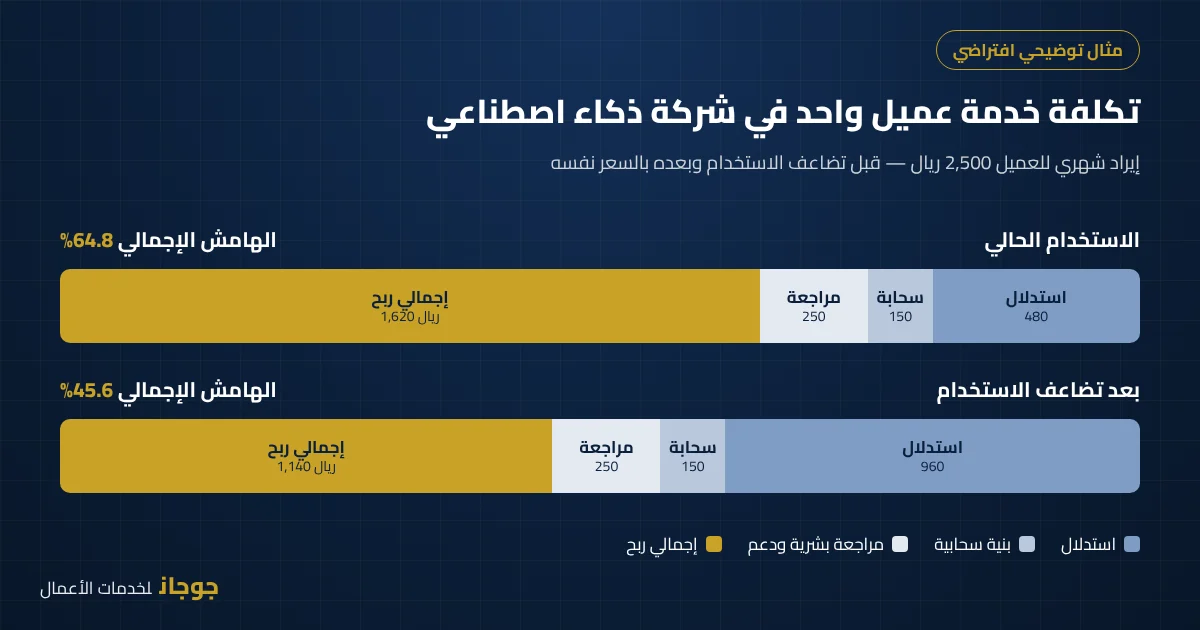
Assumptions: A company offers a product for processing Arabic medical documents for clinics. It has 120 customers, each paying SAR 2,500 per month (monthly recurring revenue of SAR 300,000). On average, a customer processes 4,000 documents per month at a hypothetical inference cost of SAR 0.12 per document (SAR 480), plus SAR 150 for cloud infrastructure and SAR 250 for human review and support allocated to each customer. Customer acquisition cost is SAR 18,000, and the monthly churn rate is 2.5% (i.e., an average lifetime of 40 months).
| Scenario | Monthly cost to serve per customer (SAR) | Gross margin | CAC payback period (months) | Customer value from gross profit (SAR) | LTV/CAC |
|---|---|---|---|---|---|
| Base case | 880 | 64.8% | 11.1 | 64,800 | 3.6 |
| Inference cost up 50% | 1,120 | 55.2% | 13.0 | 55,200 | 3.07 |
| Usage doubles at the same price | 1,360 | 45.6% | 15.8 | 45,600 | 2.53 |
| Monthly churn rises to 4% | 880 | 64.8% | 11.1 | 40,500 | 2.25 |
Calculation method: Monthly gross profit = 2,500 − cost to serve; payback period = 18,000 ÷ monthly gross profit; customer value = monthly gross profit ÷ monthly churn rate (undiscounted, for simplicity).
What does the example teach? A doubling of customer usage—which companies usually celebrate as “high engagement”—cuts the margin by about 19 percentage points in this example, because the price is fixed and the cost is variable. Higher churn, on the other hand, does not affect the margin or the payback period, but it reduces customer value by about 37.5%; that is why a single metric is not enough.
A Simplified Valuation Model with Disclosed Assumptions
Note: This is a hypothetical illustrative model for educational purposes, not a valuation of a real company or an investment recommendation. It builds on the previous example and estimates enterprise value by discounting free cash flows for five years, followed by a terminal value.
Common assumptions (hypotheses): - Starting annual recurring revenue: SAR 3.6 million. - Operating expenses (sales and marketing, development and administration) as a percentage of revenue: 80%, then 65%, then 52%, then 42%, then 35% in years 1 to 5. - Free cash flow = Revenue × (Gross margin − Operating expense ratio), with no material capital expenditure (cloud model), and before zakat, taxes and working capital changes, for simplicity. - A 30% discount rate reflecting the risks of a startup in this specific example; it is not a market reference rate. - Terminal growth after year five: 3%.
Scenarios: - A — Base case: revenue growth of 60%, then 45%, then 35%, then 25%, then 15%, with a constant 65% gross margin. - B — Provider cost shock: the same growth, but the margin falls to 55% from year two. - C — Weak retention: slower growth (40%, then 30%, then 22%, then 15%, then 10%) and a 65% margin.
| Item (SAR million) | A — Base case | B — Provider shock | C — Weak retention |
|---|---|---|---|
| Year 5 revenue | 16.21 | 16.21 | 10.11 |
| Free cash flow: Year 1 | −0.86 | −0.86 | −0.76 |
| Free cash flow: Year 2 | 0.00 | −0.84 | 0.00 |
| Free cash flow: Year 3 | 1.47 | 0.34 | 1.04 |
| Free cash flow: Year 4 | 3.24 | 1.83 | 2.11 |
| Free cash flow: Year 5 | 4.86 | 3.24 | 3.03 |
| Present value of five-year cash flows | 2.45 | 0.51 | 1.45 |
| Present value of terminal value | 4.99 | 3.33 | 3.11 |
| Estimated enterprise value | 7.44 | 3.84 | 4.56 |
If the investor weights the base case at 50% and each of the other two scenarios at 25% (a hypothetical weighting), the weighted value is approximately SAR 5.82 million.
Three readings from the model (professional analysis):
- Ten points of gross margin nearly halve the value. A decline in margin from 65% to 55%, with growth unchanged, reduced enterprise value from SAR 7.44 million to SAR 3.84 million. Negotiating the investment price without examining inference costs is therefore negotiating over a number that neither party knows.
- Terminal value accounts for about two-thirds of the value in the base case (4.99 of 7.44), meaning most of the value depends on assumptions beyond year five. This is normal for startups, but it means the valuation is highly sensitive to the discount rate and terminal growth, and should be presented as a range rather than a single figure.
- Enterprise value is not the deal price. The price is determined by negotiation, the structure of the stake, preference rights, debt and available cash—matters that require a specialized legal advisor and accountant.
For those who want to rebuild the calculation with their own figures, GOOGAN Encyclopedia provides a Net Present Value and Internal Rate of Return calculator in Excel format, into which the cash flows for each scenario can be entered.
Common Thinking Errors When Evaluating AI Companies
- Confusing the quality of the technical demo with the quality of the business: an impressive live demo proves the technology works, not that anyone will pay for it at a profitable margin.
- Calculating customer value from revenue: this inflates the result by the reciprocal of the margin.
- Assuming model costs will always fall: this may happen, but customers tend to use newer, more expensive models and longer contexts, so actual spending does not necessarily fall. Build the model on actual invoices, and test the decline as a scenario, not as the base case.
- Treating free provider credits as a permanent saving.
- Treating regulatory compliance as a later issue: in government sales and regulated sectors, compliance is a precondition for selling, not an improvement afterwards.
- Measuring retention with an overall average instead of analyzing each customer cohort.
When Is Published Information Not Enough to Make a Decision?
Public information, from provider pricing pages to regulatory documents, is enough to frame the right questions, but not enough to answer them. You need data from inside the company in the following cases:
- When the size of the investment exceeds your ability to absorb its total loss, invoices, contracts and collection statements must be examined—not presentations.
- When a large part of the growth plan relies on government customers or regulated sectors.
- When the company processes health, financial or children’s data, or transfers personal data outside the Kingdom.
- When the largest provider’s share of cost to serve is large and there is no enterprise contract.
- When the recurring revenue figures in the presentation differ from the financial statements.
In these cases, due diligence—with its commercial, financial, technical and legal components—becomes a precondition before signing, with the legal, tax and accounting aspects assigned to licensed specialists.
Investor Questions
Is a company that uses a third-party model worth less than a company that develops its own model?
Not necessarily. Developing a proprietary model raises capital costs and technical risk, and it only translates into value if it outperforms available alternatives at a justified cost. The criterion is where the value the customer pays for sits, and whether it remains if the provider changes.
What is a “good” gross margin for an AI company?
We do not adopt a benchmark figure here because there is no rigorous official source for it in the Saudi market. More important than the absolute figure is its trend as the company grows, and its ability to withstand scenarios of rising costs and doubling usage, as in the illustrative example above.
How can I verify inference costs without technical expertise?
Ask for provider and cloud invoices for the last 12 months, and compare their total with the number of customers and usage over the same period. If the per-customer cost derived from the invoices differs materially from what is in the presentation, ask for a written explanation.
Must the company host its data inside the Kingdom?
That depends on the type of data, the customers and the sector. The transfer of personal data outside the Kingdom is governed by the Regulation on Personal Data Transfer outside the Kingdom, and cloud services for government entities and critical national infrastructure are subject to the National Cybersecurity Authority’s controls and the requirements of the National Data Management Office. A ruling on a specific case requires a specialized legal advisor.
Are SDAIA’s AI Ethics Principles binding?
The principles apply to public, private and non-profit entities that develop or use AI systems, and they link their requirements to the system’s risk level. Determining the nature of the obligation for a specific product is a matter for the official text and a legal specialist. From an investment perspective, a company that has not conducted a self-assessment against them will face difficult questions from its enterprise customers.
When should I consider rapid growth a positive sign?
When it is accompanied by a stable or improving margin, a stable or shorter CAC payback period, and retention that does not weaken in more recent cohorts. Growth accompanied by a decline in any of these metrics needs an explanation before funding.
Can I rely on valuation multiples of comparable companies?
Multiples reported in the news about private funding rounds often do not disclose the deal structure or the company’s economics, so they are not a suitable reference on their own. A model based on unit economics and disclosed scenarios, like the example above, provides a clearer basis for negotiation.
Conclusion
Investing in an AI company is, at its core, investing in its ability to turn a variable compute cost—whose pricing someone else controls—into recurring revenue with a margin that holds. Start by identifying the source of value, then separate genuine recurring revenue from trials and projects, calculate cost to serve per customer from invoices rather than presentations, test the margin against rising prices and doubling usage, and review data rights and compliance as part of the financial model, not as an appendix. Use the scorecard above to guide the conversation with management, and the simplified model to see which assumption moves the value most, then focus your due diligence on it.
If you are considering funding an AI company or entering into a partnership with one, and need someone to structure the opportunity and the comparison criteria and identify the assumptions that must be tested before the decision, the Investment Advisory service at GOOGAN Consulting & Feasibility Studies covers this stage, and the Market Research service can be used when the demand in the company’s target sector needs to be tested. The legal, tax and accounting aspects of the deal remain the domain of advisors licensed in those fields.
Prepared by: Studies and Consulting Department, GOOGAN Business Services Company.
This content is general analytical and educational material and does not constitute an investment recommendation or a legal opinion.
Information last verified: 12 November 2026
Sources
- Saudi Data and Artificial Intelligence Authority (SDAIA) — AI Ethics Principles (September 2023): https://sdaia.gov.sa/en/SDAIA/about/Documents/ai-principles.pdf
- SDAIA — Generative AI Guidelines for the Public and Government Entities (January 2024): https://sdaia.gov.sa/en/SDAIA/about/Files/GenerativeAIPublicEN.pdf
- SDAIA — Personal Data Protection Platform: https://dgp.sdaia.gov.sa/
- Umm Al-Qura Gazette — Regulation on Personal Data Transfer outside the Kingdom (7 September 2023): https://www.uqn.gov.sa/details?p=23597
- Umm Al-Qura Gazette — Decision approving the Regulation on Personal Data Transfer outside the Kingdom: https://www.uqn.gov.sa/details?p=23596
- National Cybersecurity Authority — Cloud Cybersecurity Controls CCC-2:2024: https://cdn.nca.gov.sa/api/files/public/upload/6d5408a3-d8e6-4e96-963b-2c7198e5b7c2_CCC-2-2024-EN-.pdf
- OpenAI — API pricing page (accessed 12 November 2026): https://developers.openai.com/api/docs/pricing
- OpenAI — Model deprecations page (accessed 12 November 2026): https://developers.openai.com/api/docs/deprecations
- Anthropic — Pricing page (accessed 12 November 2026): https://platform.claude.com/docs/en/about-claude/pricing
- Anthropic — Model deprecation policy (accessed 12 November 2026): https://platform.claude.com/docs/en/about-claude/model-deprecations
What Is a Feasibility Study?
Key Information Needed to Prepare a Feasibility Study
How Is a Feasibility Study Prepared?
- Project Data Collection: Define the project idea, location, capacity, and target authority requirements.
- Market Study: Analyze supply, demand, competitors, and prices in the target market.
- Technical and Financial Study: Estimate investment and operating costs, revenues, and profitability indicators.
- Report and Recommendations: Deliver the final study with findings and recommendations per the target authority requirements.
How Do You Choose a Reliable Feasibility Study Office?
Look for an office with a valid commercial registration and licence, verifiable quality certifications, and experience in your sector and in the requirements of the authority receiving the study. The office should clarify its methodology, financial assumptions, scope, deliverables, and timeline from the start.
Accuracy of financial assumptions is not a small detail; an unrealistic assumption can lead to a wrong investment decision or to the study being rejected by the target authority.
Frequently Asked Questions
Is the feasibility study customized or a ready-made template
The study is prepared specifically for your project according to its nature and the target authority requirements, not a ready-made template.
How long does a feasibility study take
The duration varies by project size, sector, and target authority requirements, and is set precisely after reviewing the project data.
What information is needed to start a feasibility study
The project idea, location, expected capacity, and the target authority requirements, if any.